
Things you should not have your clients put in a letter to a buyer or seller.
Protected Class
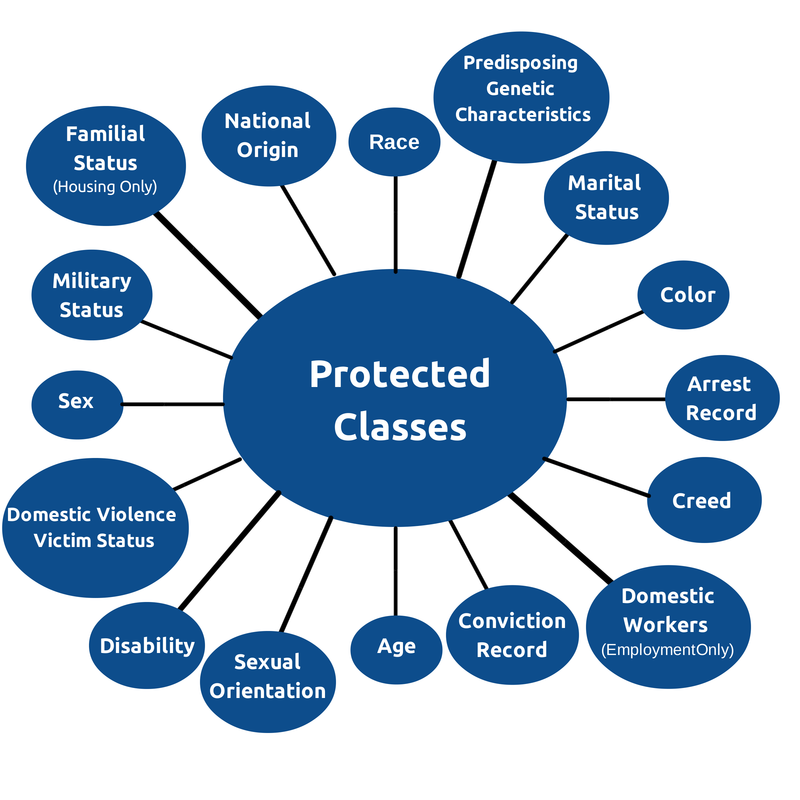
- Race.
- Color.
- Religion or creed.
- National origin or ancestry.
- Sex.
- Age.
- Physical or mental disability.
- Veteran status.
- Genetic information.
- Citizenship.More…
Discrimination is treating people differently. Discrimination is unlawful when it is based on a personal trait or characteristic protected under Human Rights Law. The traits that are protected under Human Rights Law are called Protected Classes. It is unlawful to discriminate against a member of a protected class when it comes to housing, employment, public accommodation, credit and lending, certain educational institutions, and volunteer firefighting organizations.
Rights
All citizens should be aware of their rights under Human Rights Law, including their right to file complaints against alleged acts of discrimination. In order for an alleged discriminatory act to be illegal, there must be a connection between what happened to you and the trait/characteristic protected by the Human Rights Law. Making a Human Rights complaint is free for the person making the complaint.Responsibilities
If you are an employer, housing professional, lending institution, or business, it is important to understand your responsibilities under the Human Rights Law. Awareness of the laws can help you create equitable environments in our community, as well as prevent costly and time-consuming legal proceedings.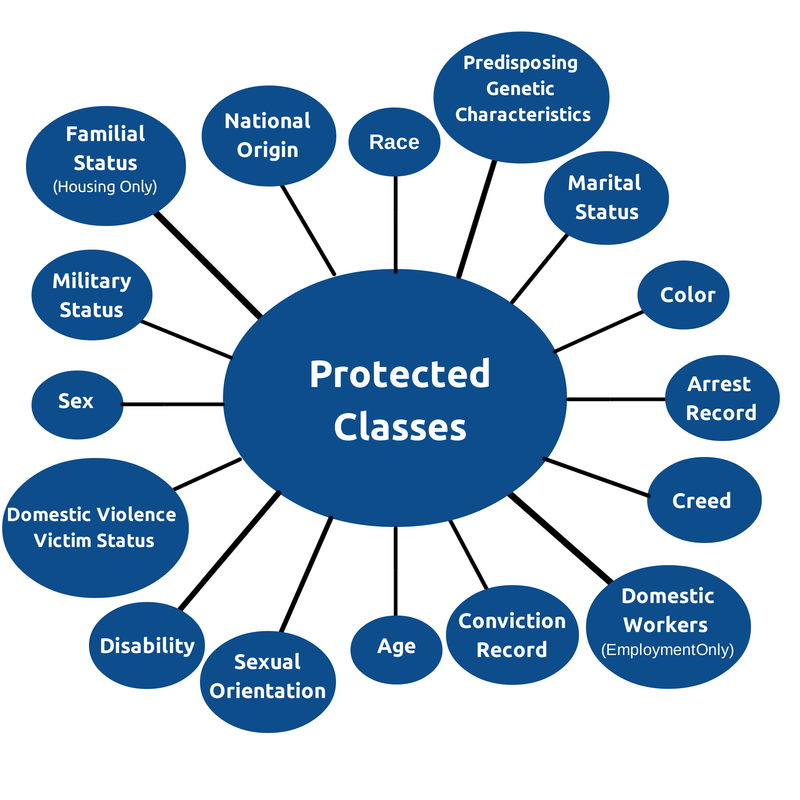
Descriptions of Protected Classes
Age
The Human Rights Law protects person(s) age 18 or older. A person cannot be discriminated against on the basis of his or her age in the area of employment or housing. Age discrimination usually occurs in employment when older workers are fired, replaced by younger workers, or treated differently than younger colleagues. Employees cannot be forced to retire except for very limited situations relative to tenured professors and certain highly paid executives.
Creed
Relates to a person’s religious beliefs. The wearing of religious garb and the observance of religious holidays and practices are protected under the Human Rights Law.
Race & Color
Race and color pertains to a person’s racial background and/or skin color.
Sex
Discrimination on the basis of sex includes unequal treatment in the workplace, sexual harassment, and pregnancy discrimination. Under the Human Rights Law, men and women are entitled to equal pay, benefits, working conditions, and seniority rights; men and women are entitled to be free from unwelcome sexual advances, requests for sexual favors, physical or verbal conduct of a sexual nature, and a hostile work environment; and pregnant women are guaranteed the right to work, and to enjoy the same medical, vacation and disability leave policies as non-pregnant co-workers. Although sex discrimination occurs most frequently in the workplace, it also occurs in areas concerning housing, credit, and public accommodations.
Sexual Orientation
The Sexual Orientation Non-Discrimination Act of January 16, 2003, amends the New York State Human Rights Law to prohibit actual or perceived sexual orientation discrimination in places of public accommodation, non-sectarian educational institutions, credit transactions, housing, commercial property, and in obtaining employment. Sexual Orientation is defined as gay, lesbian, bisexual, heterosexual, and asexual.
National Origin
Is based on one’s national group and includes one’s ancestry.
Marital Status
A person may not be discriminated against on the basis of whether or not he or she is married, divorced, single, separated or widowed.
Domestic Violence Victim Status
The New York State Human Rights Law was amended effective July 7, 2009 to provide protection from employment discrimination for victims of domestic violence. The Human Rights Law defines a domestic violence victim as an individual who is a victim of an act, which would constitute a family offense under N.Y. Family Court Act § 812. It is unlawful to discriminate against a domestic violence victim in employment and housing.
Disability
A disability is a physical, mental, or medical impairment resulting from anatomical, physiological, or neurological conditions that prevent the exercise of a normal bodily function or is demonstrable by clinical or laboratory diagnostics techniques. If a person has a record of a disability or is perceived by others to have a disability, whether or not the person does, he or she is also protected under the Human Rights Law. Under the jurisdiction of employment, a person is protected when the disability does not interfere with the ability to reasonably perform job duties. It is illegal to discriminate against people who have, are perceived to have, perceived to be at risk for HIV/AIDS.
Military Status
Discrimination on the basis of military status involves denying equal employment opportunity to any person because of that person’s past, current or future membership, service or obligation in a uniformed service.
Arrest & Conviction
It is unlawful for any person, agency, bureau, corporation or association, including the State and any political subdivision thereof, to deny employment because of an individual’s conviction record, where such denial is in violation of Article 23-a of the Correction Law. A potential employer cannot make any inquiry about an arrest record, but can inquire if a potential employee has been convicted of a crime.
Predisposing Genetic Characteristics
Employment discrimination on the basis of genetic predisposition or carrier status is prohibited by the Human Rights Law. The legislature added this protection to the law in 1996.
Familial Status (in housing only)
Discrimination in the rental, purchase, or lease of housing on the basis of familial status is prohibited. Familial status means any person who is pregnant, has a child, or is in the process of securing legal custody of any individual under the age of 18; or one or more individuals under the age of 18 living with a parent, a legal guardian, or a designee of a parent.
Domestic Workers (in employment only)
It is unlawful for an employer to engage in unwelcome sexual advances, requests for sexual favors, or other verbal or physical conduct of a sexual nature to a domestic worker when: (i) submission to such conduct is made either explicitly or implicitly a term or condition of an individual’s employment; (ii) submission to or rejection of such conduct by an individual is used as the basis for employment decisions affecting such individual; or (iii) such conduct has the purpose or effect of unreasonably interfering with an individual’s work performance by creating an intimidating, hostile, or offensive working environment.

Two Big Myths in the Homebuying Process
Two Big Myths in the Homebuying Process The 2020 Millennial Home Buyer Report shows how this generation is not really any different from previous ones when it comes to homeownership goals: “The majority of millennials not only want to own a home, but 84% of...

5 Simple Graphs Proving This Is NOT Like the Last Time
5 Simple Graphs Proving This Is NOT Like the Last Time With all of the volatility in the stock market and uncertainty about the Coronavirus (COVID-19), some are concerned we may be headed for another housing crash like the one we experienced from 2006-2008. The...

Yes, You Can Still Afford a Home
Yes, You Can Still Afford a Home The residential real estate market has come roaring out of the gates in 2020. Compared to this time last year, the number of buyers looking for a home is up 20%, and the number of home sales is up almost 10%. The increase in purchasing...

Confidence Is the Key to Success for Young Homebuyers
Confidence Is the Key to Success for Young HomebuyersBuying your first home can seem overwhelming. Thankfully, there’s a lot of great information out there to help you feel more confident as you learn about the process. For those in younger generations who aspire to...

Equity Gain Growing Across Utah and in Nearly Every State
Equity Gain Growing in Nearly Every State Rising home prices have been in the news a lot lately, and much of the focus is on whether they’re accelerating too quickly and how sustainable the growth in prices really is. One of the often-overlooked benefits of rising...
Mortgage rates fell to their lowest level March 2020
Mortgage rates fell to their lowest level on record Thursday, pulled down by fears that the spread of coronavirus could weigh on the U.S. economy. The average rate on a 30-year fixed-rate mortgage fell to 3.29 percent from 3.45 percent last week and down from 4.41...

Thinking of Getting Your House Ready to Sell?

Impact of the Coronavirus on the U.S. Housing Market
Impact of the Coronavirus on the U.S. Housing MarketThe Coronavirus (COVID-19) has caused massive global uncertainty, including a U.S. stock market correction no one could have seen coming. While much of the news has been about the effect on various markets, let’s...

How Interest Rates Can Impact Your Monthly Housing Payments
How Interest Rates Can Impact Your Monthly Housing Payments Spring is right around the corner, so flowers are starting to bloom, and many potential homebuyers are getting ready to step into the market. If you’re thinking of buying this season, here’s how mortgage...

How Your Tax Refund Can Move You Toward Homeownership This Year
How Your Tax Refund Can Move You Toward Homeownership This Year If you’re looking to buy a home in 2020, have you thought about putting your tax refund toward a down payment? Homeownership may be one step closer than you think if you spend your dollars wisely this...